Blog
How a Legal Virtual Assistant Helps Small Firms Recover Billable Hours
September 24, 2026 · Mauricio Montaldo
The managing partner is not losing the afternoon to a mystery. The afternoon is going to the calendar that still needs a deposition reset, the intake form that arrived without a conflict-check packet, and the client who called three times about a status the file already shows.
- Top 1% applicants
- Time-zone aligned
- 98% retention
A legal virtual assistant exists for that pile — the operational work that keeps licensed counsel off a billable hour.
This is not another “hire help and grow” essay. It is a delegation map for a small firm: what a US-managed assistant can own, what must stay with a licensed lawyer, and how the first 30 days should look if you want the seat to stick.
Where billable hours actually leak
The U.S. Bureau of Labor Statistics puts the median wage for lawyers at $159,670 a year as of May 2025 — $76.76 an hour. Most lawyers work full time, and some work more than 40 hours a week. That number is the cost of the person who can advise a client and appear in court. It is a poor use of that hour to rebuild a hearing calendar or chase a missing medical record.
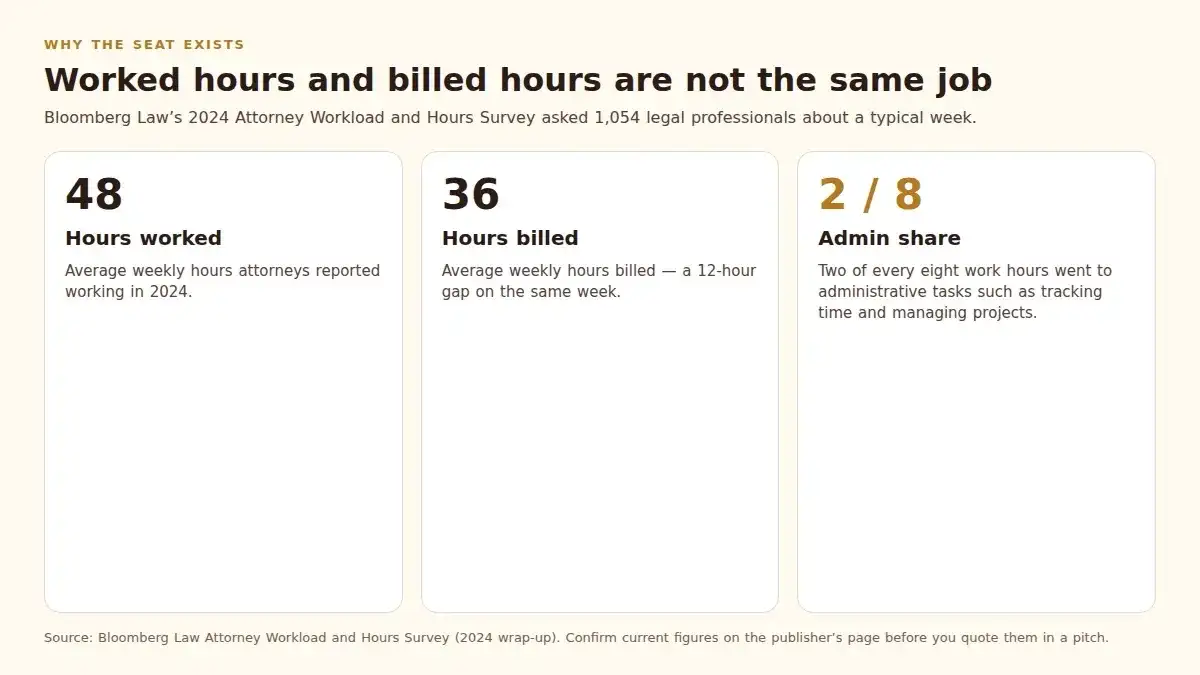 Bloomberg Law’s 2024 Attorney Workload and Hours Survey found a 12-hour gap between a typical week worked and a typical week billed, with two of every eight hours going to administration.
Bloomberg Law’s 2024 Attorney Workload and Hours Survey asked 1,054 legal professionals about that year. It was fielded online from January 8 to January 27, 2025. Among the 58 percent who bill by the hour, that unpaid gap was administrative work such as tracking time and managing projects.
Those figures are a national snapshot, not your realization report. They still name the problem a solo or three-lawyer shop already feels: the week is full, the billed week is thinner, and the gap is often calendar, intake, and file chase.
A local W-2 legal secretary is one way to close that gap. It is not only the wage. In June 2026, the BLS Employer Costs for Employee Compensation release put private-industry benefit costs at 30.0 percent of employer compensation — $14.07 of a $46.89 hourly total, with wages at $32.82. That is the economy-wide mix, not a law-firm benefits quote. It is enough to remember that “what we would pay a secretary” is not the full cost of a local hire.
The BLS occupational profile for paralegals and legal assistants is useful for a different reason. Median pay in May 2025 was $62,890 — $61,770 inside legal services. The duty list is the work lawyers already know: gather and organize documents, draft correspondence, schedule interviews and depositions, help prepare for hearings. That is support under lawyer direction. It is not a license to practice.
A Meet My Assistant legal seat is not a paralegal by default. If you need paralegal-level experience for a specific docket, say so on the discovery call so screening matches the actual file, not a generic “legal assistant” title.
What a legal virtual assistant can own
On the legal virtual assistant page, the seat is college-educated, bilingual English/Spanish support for small firms and growing practices. Matching, onboarding, and a US-based Customer Success Manager sit with the agency. The assistant works in the software you already run.
The useful test is simple: if the task keeps a partner off a billable hour and does not require legal judgment, it belongs on this list.
- Calendar, court dates, depositions, and internal meetings
- New-client intake: forms, the conflict-check packet you define, consult scheduling
- Document assembly: packets, formatting, exhibits, e-sign routing
- Client communication you approve — status language, appointment reminders, portal nudges
- File hygiene: naming, checklist tracking, follow-up on missing items
- Vendor and expert scheduling (medical records, court reporters, translators)
- Bilingual intake and updates when callers are not all English-first
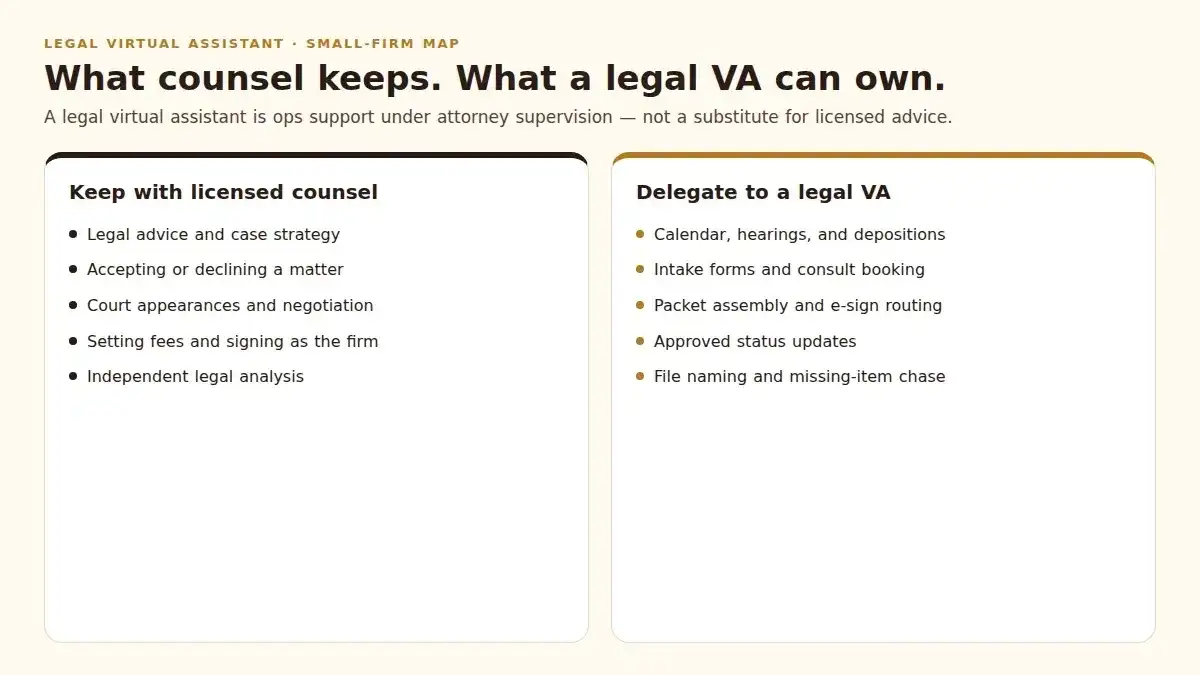
Keep advice, strategy, and court work with licensed counsel. Give the legal virtual assistant the calendar, intake, and file-chase work that interrupts drafting.
Public videos and posts about this hire keep returning to the same week: calendar, inbox, intake, docketing, document prep. That is the demand. What most of those clips skip is the supervision rule. The assistant can assemble the packet. The lawyer decides what the packet means.
Tools are yours, not a platform swap. Firms already on Clio, MyCase, PracticePanther, Smokeball, Outlook, Google Workspace, DocuSign, Dropbox, or a shared phone system grant access after they choose the person. You do not rebuild the stack to make the hire work.
Consumer-facing practices — personal injury, family, estate, immigration-adjacent admin — often feel the bilingual piece first. The missed call is not a marketing problem. It is a first-conversation problem. A Spanish-speaking intake seat does not replace counsel. It keeps the consult from dying in voicemail.
What must stay with licensed counsel
A legal VA is not your lawyer.
The Florida Bar’s consumer pamphlet on hiring legal help is blunt: generally only a licensed member of The Florida Bar can help with a legal problem and give legal advice. A nonlawyer cannot give legal advice and cannot go to court. Paralegals who work in a law office work under a lawyer’s supervision; they are not offering services directly to the public. The pamphlet was updated in November 2022.
Florida’s definition is written into Rule 10-2.1 of the Rules Regulating The Florida Bar (June 2026 compilation). A paralegal or legal assistant is a person who works under the supervision of a member of The Florida Bar — or an authorized out-of-state or foreign lawyer — and performs specifically delegated substantive legal work for which the supervising lawyer is responsible. A nonlawyer may not offer legal services directly to the public.
Other states write the same idea in different language. Confirm your bar’s unlicensed-practice rules before you write the job description. This article is not legal advice.
In practice, that means the assistant does not:
- Give legal advice or choose a strategy
- Accept or decline a matter
- Appear in court or negotiate for a client
- Set fees or sign as the firm
- Do independent legal analysis and call it “document prep”
Document work is assembly and formatting under attorney direction. Status language is language you approve. Intake is facts and scheduling, not a diagnosis of the claim.
Confidentiality agreements are standard on this seat. Access is limited to the systems you grant. If your practice has extra rules — conflict software, a client portal, a records vendor — those rules go in the week-one packet, not in a Slack thread three weeks later.
US-managed matching versus a marketplace contractor
A freelance marketplace can look cheaper on the first invoice because you are buying a poster, not a hiring process. You also become the recruiter, the trainer, and the person who finds a replacement when the contractor disappears mid-docket.
Meet My Assistant is a US-managed virtual assistant agency, not a US-staffed executive-assistant firm and not a freelance board. Assistants live and work in Latin America. Matching, onboarding, and customer success sit in the United States — the office is in Sunny Isles Beach, Florida. Default overlap is Eastern and Central time. You interview shortlisted people. You approve the hire. A Customer Success Manager stays on the account.
The hiring process is Align, Match, Interview, Onboard. The FAQs add the operational detail: a discovery call, candidate interviews, a contract and kick-off after you choose someone, and an optional onboarding call. If the fit fails, you talk to customer success first. The agency works the issue or replaces the seat.
That replacement path is the part marketplace buyers skip until they need it. A law firm cannot treat “we will find someone else on the platform” as a continuity plan for a matter file.
If you need the person on a US employment contract or sitting in a US office, say so on the call. That is a different product. If you need the cheapest hourly poster you can find, this model will feel like too much process — because the process is the product.
The first 30 days of a law-firm handoff
A seat fails when the firm dumps “everything admin” into a shared inbox and hopes. The first month should look like a controlled handoff, not a personality test.
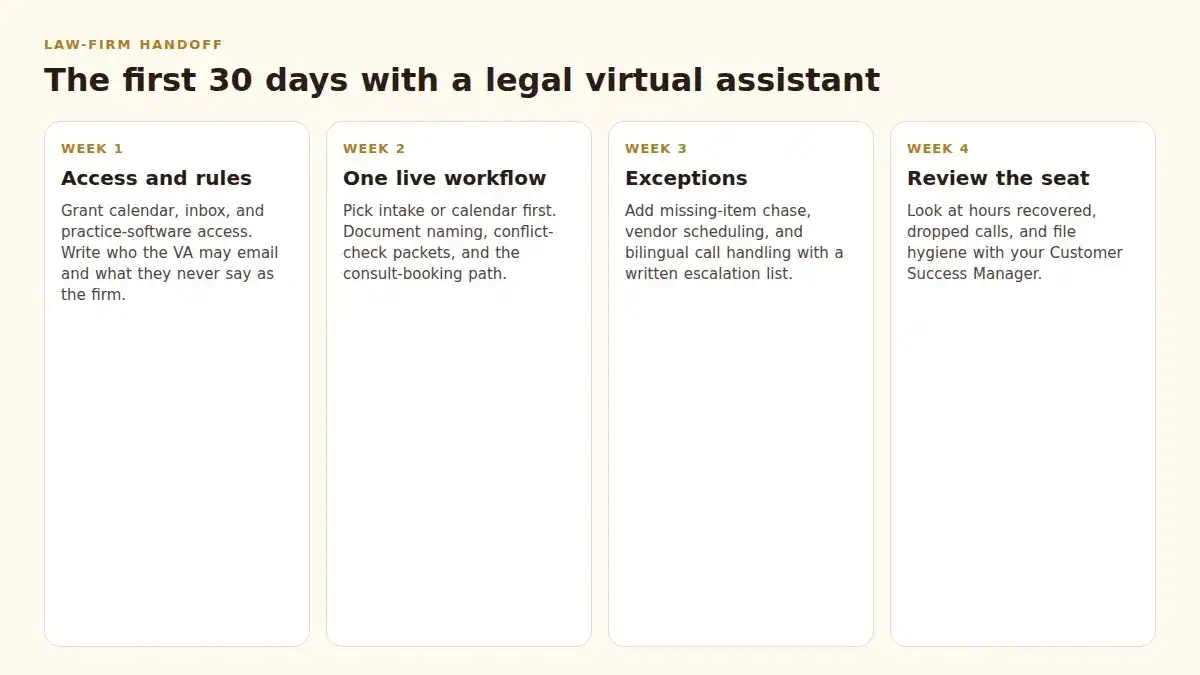 Week one is access and rules. Week two is one live workflow. Week three adds exceptions. Week four is a review of hours recovered and file hygiene.
Week 1 — Access and rules. Grant calendar, inbox, and practice-software access. Write who the assistant may email, which numbers they answer, and the sentences they never use as the firm. Name the supervising attorney. Put the confidentiality agreement and the systems list in one packet.
Week 2 — One live workflow. Pick intake or calendar. Not both. Document the naming convention, the conflict-check packet you already use, and the consult-booking path. The assistant runs that path on live matters while you still watch the exceptions.
Week 3 — Exceptions. Add missing-item chase, vendor scheduling, and bilingual call handling. Give a written escalation list: what they handle, what they draft for your approval, and what they never touch. This is where most firms either get their time back or create a second bottleneck.
Week 4 — Review the seat. Look at dropped calls, time-to-consult, file hygiene, and the hours you actually spent on admin compared with the month before. Do that review with your Customer Success Manager, not only in your head on a Sunday night.
The optional onboarding call in the FAQs is useful here. Use it to lock the week-one packet, not to “get to know each other.”
Who this seat is for — and who it is not
Solo and small practices usually need the first dedicated ops seat: phones, calendar, and intake that currently interrupt drafting. One assistant who owns those three loops is more useful than a freelancer who “can also do social.”
Growing firms need intake and document throughput that does not depend on whoever is already late to a hearing. The assistant becomes the checklist owner between attorneys, staff, and clients.
Consumer-facing dockets with Spanish-speaking callers need bilingual coverage at the first contact, not a translation app after the lead has gone cold.
This is the same industry lane as MMA’s healthcare and real estate seats: operational support around a licensed professional, not a substitute for the license.
It is the wrong hire if you want someone to give advice, appear in court, or run a file without a supervising attorney. It is the wrong hire if you will not grant system access or write a two-page rule sheet. And it is the wrong hire if what you actually need is a full-time, in-office legal secretary on a US W-2.
If intake, calendar, and document chase are running the firm, book a discovery call. You interview the shortlist. Onboarding and a Customer Success Manager stay on the account. Call (786) 859-8131 if you would rather talk first.
This article is educational, not legal advice. Unlicensed-practice rules vary by state. Confirm details on the official pages linked above and with counsel in your jurisdiction before you change how the firm delegates work.