Blog
How a Sales Virtual Assistant Keeps Leads From Going Cold
October 2, 2026 · Mauricio Montaldo
A sales virtual assistant exists for the hour after a web form lands, when the closer is already on another call. That hour covers the reply, the CRM note, and a time on the calendar so the live deal still has a next step.
- Top 1% applicants
- Time-zone aligned
- 98% retention
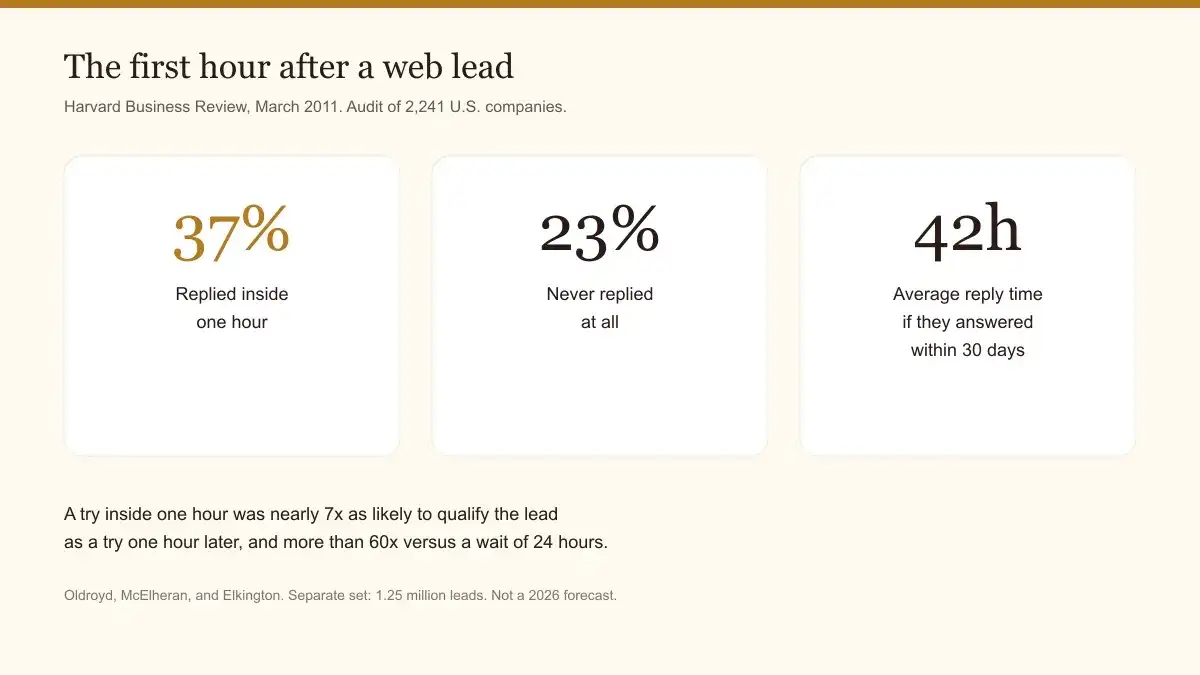
Most teams already paid for the inquiry. The ad, the referral, or the page did its job, and then the record sat in a shared inbox. In March 2011, James Oldroyd, Kristina McElheran, and David Elkington published “The Short Life of Online Sales Leads” in Harvard Business Review. They sent a web-generated test inquiry to 2,241 U.S. companies and timed the reply.
| What the company did | Share of the 2,241 |
|---|---|
| Replied within one hour | 37% |
| Replied between one hour and 24 hours | 16% |
| Took longer than 24 hours | 24% |
| Never replied | 23% |
Among the companies that did answer within 30 days, the average response time was 42 hours.
The same Harvard Business Review article found that a contact attempt inside one hour was far more likely to produce a real conversation than a later attempt. The study is from 2011. Use the pattern, not the multiplier, as a forecast.
A second dataset in that article covered 1.25 million sales leads received by 29 consumer companies and 13 business-to-business companies. Firms that tried to reach the person within an hour were nearly seven times as likely to qualify the lead as firms that tried an hour later. Qualify, in their definition, meant a meaningful conversation with a decision maker. Those same fast firms were more than 60 times as likely to qualify the lead as firms that waited 24 hours or longer.
Treat the date as part of the fact. This is a March 2011 magazine article. David Elkington, one of the authors, was CEO of InsideSales.com, and that company’s data sat under the research. The shape is what travels: many companies are slow, many never answer, and the conversation gets harder as the clock runs. The multiplier is not a forecast for your next campaign.
Public videos on this topic mostly demo an AI email sequence or a CRM automation that fires reminders. That tooling can nudge a task. It does not decide that a thread has turned into a pricing question and should leave the sequence. A person with a written rule does.
Why the first hour is an operations problem
The closer is usually on a demo, in a negotiation, or rebuilding a proposal the buyer marked up overnight. The new form is a different job: read it, answer in the company’s voice, log the source and the next step, and put a time on a calendar if the person is a fit.
When that job has no owner, it falls to whoever sees the notification. On a Thursday with three late-stage deals, that is often nobody. Friday’s forms then wait until Monday, already outside the window the 2011 audit treated as the difference between a conversation and a cold record.
A fast reply can still do damage. A note that invents a discount, books a meeting the closer cannot attend, or promises a feature the product does not have costs more than a short, accurate one. The operations problem is two lines: who answers, and what they are allowed to say.
Write those lines before you hire. One page is enough: who you sell to, who you decline, the questions that qualify, the calendar link, and the cases that stop the assistant and ping the closer. Budget, a named competitor, and an angry thread are the usual three. A new person cannot infer that list from a Slack scroll.
Teams already on Salesforce, HubSpot, Pipedrive, a shared inbox, and a dialer do not need a new stack. They need a named seat inside the stack they have, with access granted after the interview. Meet My Assistant’s sales support page describes that seat as prospecting, inbound replies, appointment setting, follow-up, and CRM notes under US-managed oversight. The page does not publish an hourly rate. The US hiring model says the quote comes after a discovery call maps the role.
What a closer's hour costs
A slow inbox feels free because it does not show up as a line item. The closer’s hour does.
The Bureau of Labor Statistics handbook for wholesale and manufacturing sales representatives puts the May 2025 median for that combined occupation at $76,460 a year. The two specialties sit on either side of that figure: $72,080 except technical and scientific products, and $104,920 for the technical and scientific specialty.
Those figures are national medians for people whose job is to sell. They are not a virtual-assistant quote and they are not your commission plan. They show the price of an hour spent rebuilding CRM fields between calls.
The same handbook lists sales managers, in a related-occupations table, at a May 2025 median of $148,270. If the person who should be coaching the pipeline is clearing the overnight forms, that is the wage on the work.
The broader sales group is a poor yardstick. BLS sales occupations show a May 2025 median of $38,530 for the whole group, below the $50,980 median for all occupations, because the group includes cashiers and retail roles. Employment in the group is projected to decline from 2025 to 2035, yet about 1.7 million openings a year are still projected because people leave. That is replacement demand. An inbox process that depends on one closer never quitting will break when the seat turns over.
A local W-2 hire adds benefits and recruiting on top of the wage. In the June 2026 Employer Costs for Employee Compensation release, full-time private-industry workers cost employers $54.00 an hour on average: $36.97 in wages (68.5 percent) and $17.03 in benefits (31.5 percent). That mix is the whole private economy, including jobs that are not sales. Commission plans will not match it. It still shows why “coordinator pay” understates a local seat.
Meet My Assistant does not publish a public “from $X an hour” figure for this seat. The hiring page says a full-time or part-time quote comes after the role is mapped. Assistants live and work in Latin America. Matching, onboarding, and a customer success manager sit with the US company in Sunny Isles Beach. If you need a person on a US employment contract in your office, this is a different product, and the hiring page says so.
What a sales virtual assistant can own
Use a simple test. If the task keeps a closer on a live deal, and it does not require the closer’s judgment about price or fit, it can sit with the assistant.
On a normal week that list looks like this:
- First reply to inbound forms, using language you approved
- Logging source, company, need, and the next step in the CRM you already run
- Booking meetings on the closer’s real calendar, inside the hours you marked as open
- Follow-up on no-shows and on quotes that have gone quiet, on a cadence you set
- List hygiene: duplicates, bounced addresses, and stages that no longer match the thread
- Research prep before a call: the site, the last notes, the open question
- Handoff notes the closer can read in a minute, not a transcript of the whole inbox
Public hiring posts for this title keep repeating three duties: prospecting, follow-up, and appointment setting. They rarely say who is allowed to change a price. Outbound can wait until that inbound queue is stable. Prospecting, a first touch, and a booked meeting are on the sales support page, and they still use the talk track you wrote.
Tools follow the same rule. LinkedIn Sales Navigator, ZoomInfo, Salesforce, HubSpot, Pipedrive, Dialpad, and Google Workspace show up on the sales page because teams already use them. You grant access after you choose the person. You do not migrate the pipeline to make the hire work.
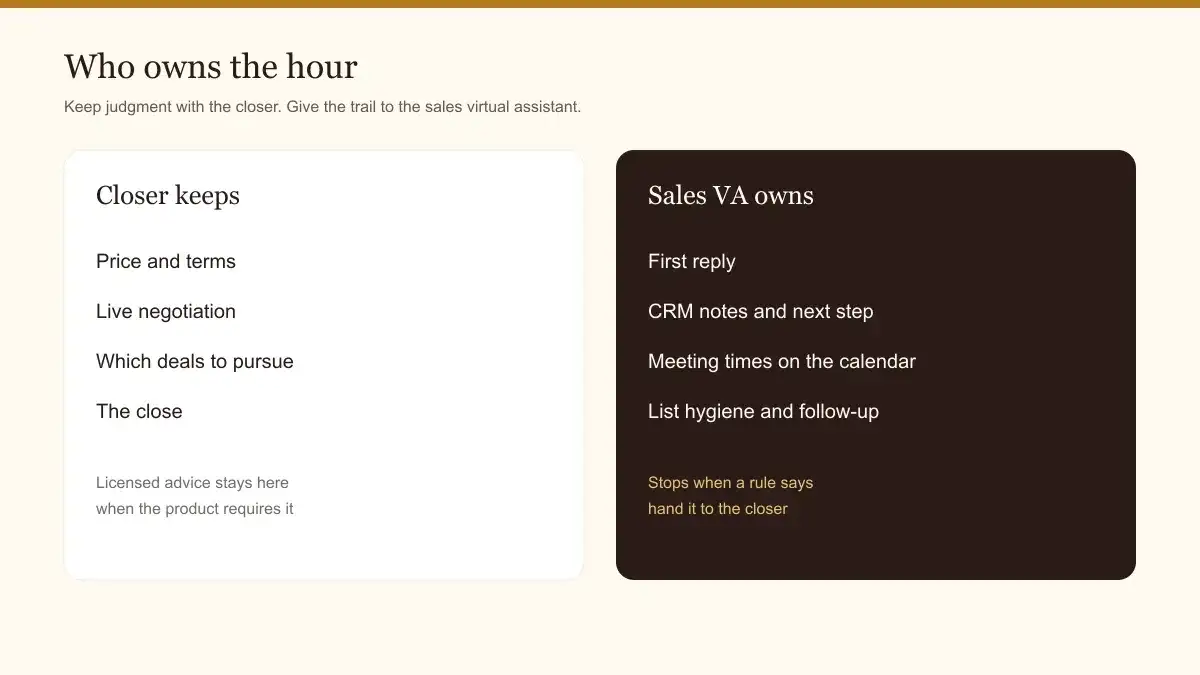 Price, negotiation, and the close stay with the closer. The sales virtual assistant keeps the reply, the CRM, and the calendar moving until a written rule says to stop.
The handoff note is the artifact that makes this real. A useful note has five fields: who they are, what they asked, what you already told them, when they can meet, and what the closer should not re-ask. If the note is a forwarded email with no summary, the closer still does the reading, and the hour you meant to save is still gone.
What stays with the closer
The assistant can prepare the meeting. The closer decides whether the meeting should exist, what the offer is, and how to handle a push on price.
Keep these with the person who owns the number:
- Discounts, payment terms, and custom scope
- Telling a prospect you will or will not pursue the deal
- Negotiation once the buyer is comparing you with a named alternative
- Any recommendation that requires a license to give
The hiring page already draws a bright line around licensed work. Clinical care, showing homes, and practicing law stay with the licensed person. The same instinct applies when the sale itself is a licensed recommendation, such as binding an insurance policy or advising on a security. The assistant can book, remind, and log. The licensed person speaks for the product. This article is an operations guide, not legal advice about who may sell what in your state.
A buyer who asks for 20 percent off to sign this week is past admin work. The written rule should send that thread to the closer the same day, with the note attached.
Voice and judgment are different gifts. Voice is a sample of emails you approve. Judgment is the exception list. Review a handful of sent notes in the first month so the voice does not drift toward whatever the last thread rewarded.
The first month, one workflow at a time
The hiring page’s sequence is a discovery call, screening, an interview you control, then onboarding with a customer success manager and a replacement path if the fit fails. The kick-off is not the moment to hand over every queue.
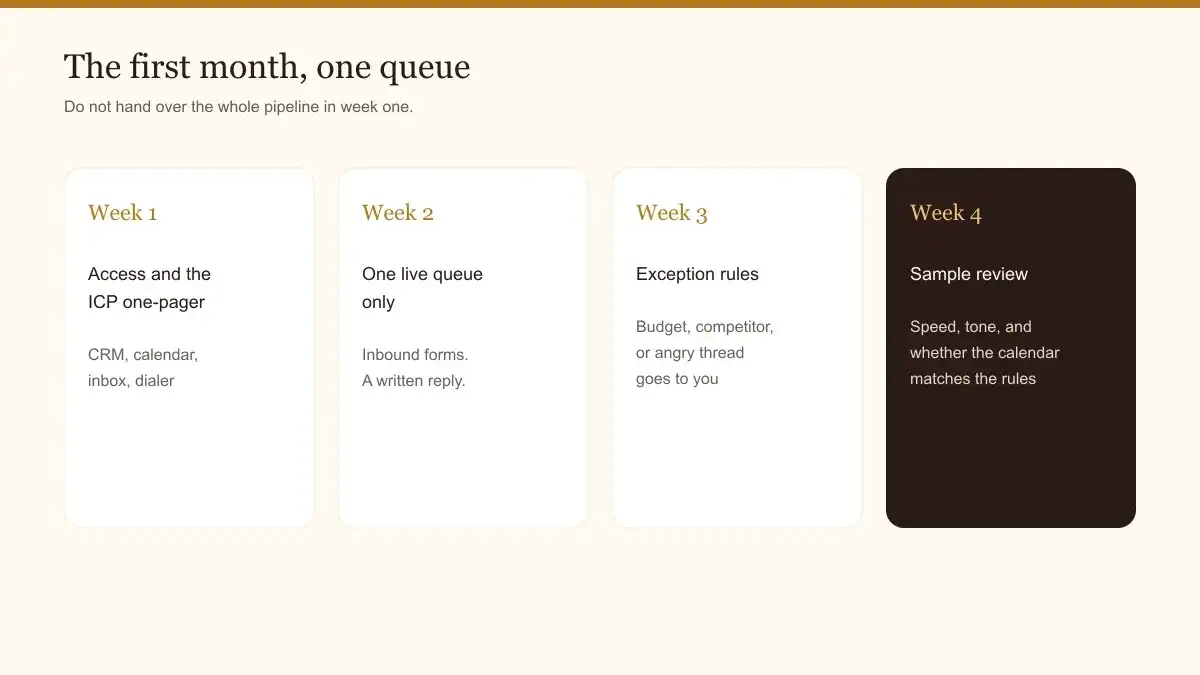 Week one is access and a one-page brief. Week two is a single inbound queue. Exceptions and a sample review come after the reply is reliable.
Week one opens the CRM, calendar, inbox, and dialer with the least access that still lets the person work, plus the one-page brief: who you want, who you decline, and the sentence for a polite no.
Week two runs a single queue, inbound web forms. Each record has a timestamp. The assistant uses the written reply, logs the five fields, and books only inside the hours you opened. You read the notes.
Week three moves the exception rules into the CRM: a task or a view the closer actually sees. No-show follow-up stays on this same queue.
Week four reviews about ten threads with the customer success manager. Speed, tone, and whether meetings landed in a real open block. Fix the calendar and the required fields before you add a second channel such as outbound or chat.
When a sales seat is the wrong hire
Skip this hire when the work is one fully specified task. A one-time list scrape with a written column map does not need a managed seat. The hiring page is plain that a marketplace can be cheaper on the sticker, and that you then own sourcing, quality, and the replacement when that person leaves.
Skip it when you need someone in a US office on your payroll. Eastern and Central overlap is part of the model. A desk in your building is not.
Skip it when you want the assistant to be the closer. If nobody on your side can take a qualified meeting, more bookings become a calendar of cancellations. Free or hire the closer first.
Skip it when you will not write the rules. Without an ideal-customer note and an exception list, the person will freeze or invent. Both get described later as “the assistant did not work.” Both start as a missing page.
A short project can still fit. The FAQ says short-term work is available, and a strong fit can extend. Use the window to prove one queue. Do not use it to skip the brief.
Put the first hour on a named person
Pick one number you can see without a new dashboard: the share of new inbound records that receive a human reply the same business day, and whether that reply matches the language you approved. If you cannot count it, you do not have an owner yet. The 2011 audit’s 42-hour average is what an unowned inbox tends to become. Your CRM timestamps will tell you whether yours already has.
When the same-day reply is the goal, staff it as a job. Map the queue, interview the person, and keep price and the close with the closer. Book a discovery call and we will quote the seat after that map, or call (786) 859-8131.
Meet My Assistant is a US-managed agency. Assistants are college-educated and based in Latin America. Rates depend on hours and scope. Confirm the current process on the site before you plan headcount around it.