Blog
Why More Healthcare Providers Are Hiring Virtual Assistants
November 14, 2024 · Updated Oct 22, 2026 · Mauricio Montaldo
A full book can still turn into a quiet afternoon. The visit was on the schedule, and the patient did not come.
- Top 1% applicants
- Time-zone aligned
- 98% retention
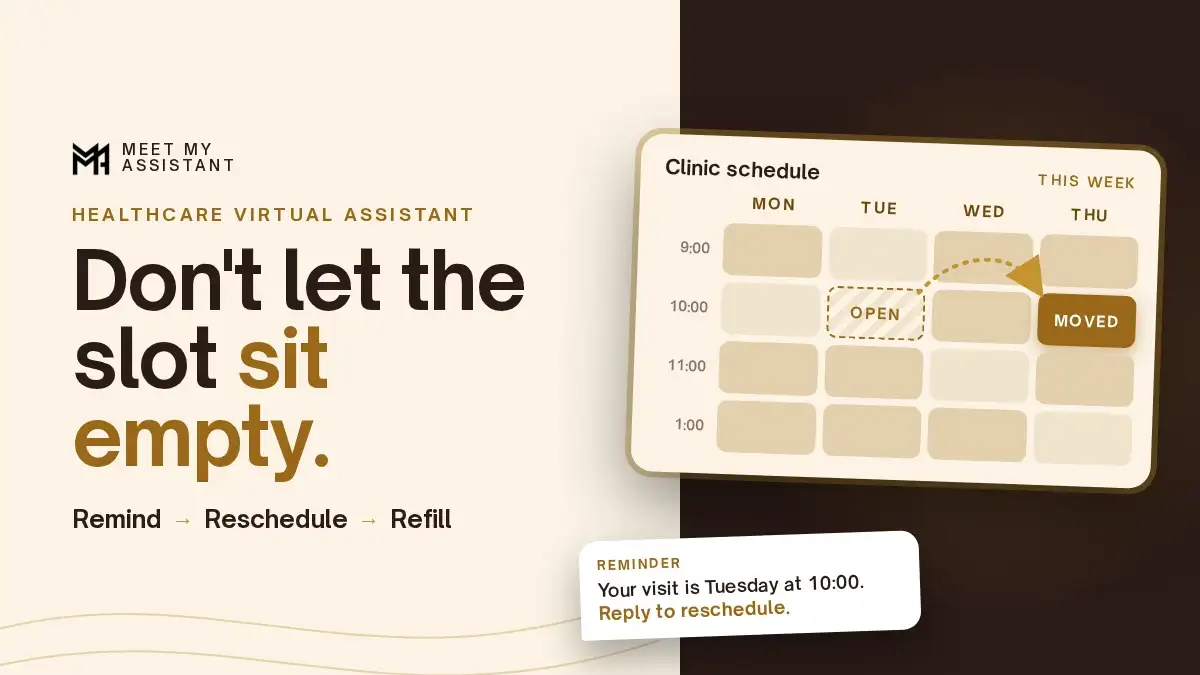
An empty hour stays blocked until someone sends a reminder, takes the cancellation, and refills the slot. This article walks that loop: the reminder, the reschedule, the records and insurance items that move with the visit, and the decisions that stay with licensed staff. It is an operations map, not clinical guidance, and it does not report results from Meet My Assistant clients.
Why a booked visit still goes empty
Two public research lines describe the pressure around a clinic day. They measure different things.
In a 2016 time-and-motion study, Christine Sinsky and colleagues observed 57 U.S. physicians in family medicine, internal medicine, cardiology, and orthopedics, in four states, for 430 hours. During the office day, those physicians spent 27.0% of their time in direct clinical face time with patients and 49.2% on electronic health record and desk work. The authors' conclusion is the sentence practices repeat: for every hour of face time, nearly two more hours went to record and desk work inside the clinic day. Twenty-one physicians also kept after-hours diaries and reported another one to two hours a night, mostly on the record. The American Medical Association funded the study. The authors say the offices were self-selected and, with one exception, considered themselves high-performing, so the split is not a national average. (Annals of Internal Medicine, via PubMed)
That 49.2% is physician time. Much of it is the note, the order, and the review of a result. Those tasks stay with the licensed clinician. The study is context only: the day is already crowded with work that is not face to face, so the scheduling layer around the visit has to run without borrowing the person in the exam room.
Missed visits are a separate measurement. A 2018 systematic review by Leila F. Dantas and colleagues covered 105 studies across specialties. They put the average no-show rate at on the order of 23%, highest in the studies from Africa (43.0%) and lowest in Oceania (13.2%). The determinants those studies most often found significant were a long gap between the booking and the visit, and a prior no-show. (Health Policy, via PubMed) The figure mixes countries and specialties. It is not a U.S. benchmark, and it is not your practice's no-show report.
Primary care studies land in a wide band as well. Joanne Parsons, Carol Bryce, and Helen Atherton reviewed missed appointments in general practice for the British Journal of General Practice. Nineteen of the included studies reported a rate. The mean was 15.2%, the median was 12.9%, and the range ran from 3.3% to 48.1%. The reasons named most often were work or family commitments, forgetting, and trouble getting to the clinic. (Full text on PMC) Forgetting, and a long wait between booking and the day itself, are the pieces a reminder and a reschedule can touch. A transportation barrier is not something a calendar edit solves.
What reminder research actually measured
Sionnadh Mairi McLean and colleagues synthesized systematic reviews and randomized trials on appointment reminders. The paper is the TURNUP review, in Patient Preference and Adherence. Simple reminders, meaning date, time, and place, raised attendance compared with no reminder. In the systematic reviews they pooled, the relative risk of attendance sat between 1.06 and 1.10. They did not find a clear winner among text, phone, and other reminder types for attendance itself. (Full text on PMC)
Cancellation is a different outcome, and the evidence is thinner. In three trials, patients who received a personal phone reminder cancelled or rescheduled 17% to 26% of the time, against 8% to 12% among people who received no reminder. Clinics in the studies McLean's group cites then reallocated 27% to 40% of the cancelled slots. The same review reported that text-message reminders did not show that cancellation increase. The authors connect that to how texts are usually sent: they announce the visit, and they do not always let the patient rebook in the moment. Those ranges are findings from the trials in that review. They are not a forecast for any one clinic, and they are not a Meet My Assistant result. (McLean et al., on cancellation and reallocation)
Timing inside that window did not hurt attendance. McLean and colleagues report strong evidence that a reminder sent anywhere from 1 to 7 days before the appointment has no adverse effect on whether the patient attends. (Timing of reminders)
The operational reading is narrow. A message that only announces the visit is not the same thing as a path to cancel and rebook. The attendance effect in the pooled reviews is modest. The design that matches the research is the one that changes the calendar when the patient says they cannot come.
A reminder and reschedule workflow
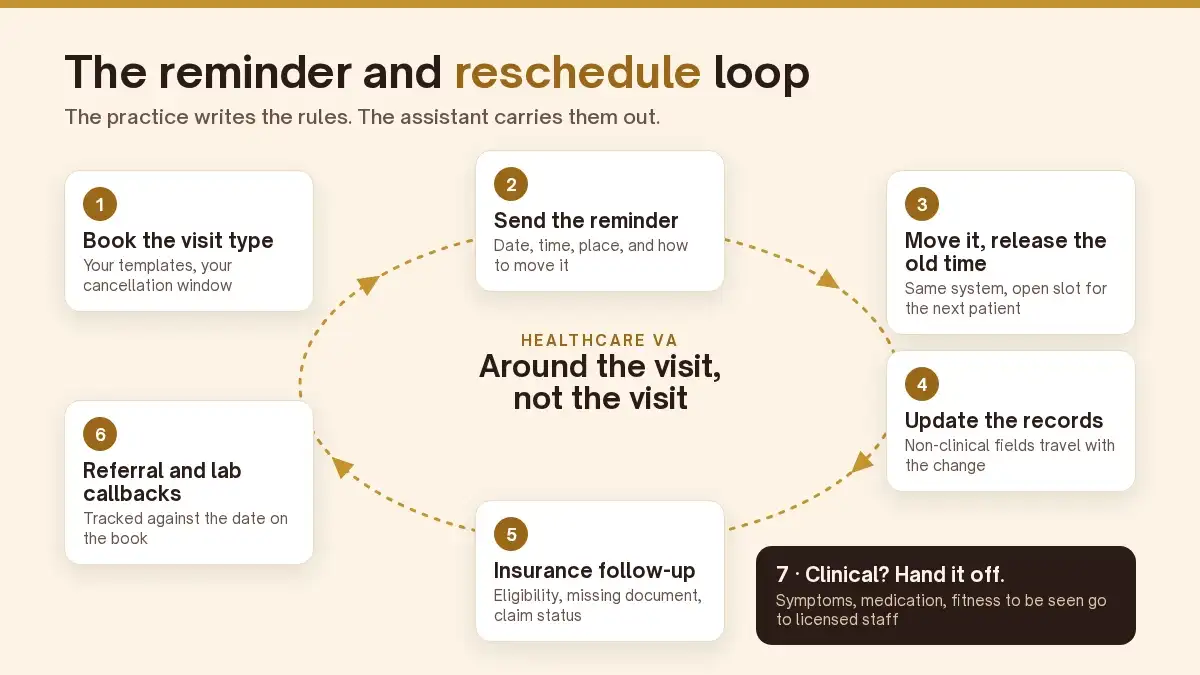
Every step below is a task already listed for a healthcare virtual assistant.
The practice writes the rules. The assistant carries them out.
-
Book the visit type. Scheduling and rescheduling use your templates and your cancellation window. The assistant does not invent a new visit type.
-
Send the reminder. The patient messages carry the date, time, and place, and they say how to move the visit. You choose the day you send them.
-
Move it, release the old time. The change happens in the same system, and the old time opens for the next patient. If a same-week refill needs a clinician's approval, that approval stays with licensed staff.
-
Update the records. Non-clinical fields travel with the change. Intake and demographic updates are virtual administrative assistant work in the system you opened. A corrected address, a new phone number, a finished intake form, and the fact that the visit moved from Tuesday to Thursday are that kind of entry. The clinical note is not.
-
Insurance follow-up. That is an eligibility check, a missing document, and claim status, done before the patient arrives. If a document is missing, the assistant requests the document. Coding and billing of record stay out of this step unless you add that scope and compliance permits it.
-
Referral and lab callbacks. The assistant tracks the request and the reply against the date on the book. Reading the result stays with the clinician.
-
Clinical? Hand it off. Symptoms, a medication question, and whether the patient is well enough to be seen go to licensed staff. That reply is not a scheduling decision.
Both languages sit on this loop. The healthcare page describes English and Spanish coverage as useful for scheduling, for reminders, and for insurance questions, so a family that speaks Spanish gets an answer in that language instead of a delayed handoff to someone who could not take the question.
Rebooking a cancellation on three calendars
The reminder is the same. The book it has to land on is not.
A private practice usually has one book. The failure is a reminder that names the wrong visit length, or a cancellation that sits unread until the morning of the appointment. The assistant applies the cancellation window you wrote, offers the next time that fits that visit, and leaves the book matching what the patient agreed to.
A specialty office or a dental office cannot refill a cancelled procedure block with a short follow-up. The reminder has to name the visit type, and the reschedule has to put the patient back on that same type of slot. A confirmation can go out while the clinician stays with the person already in the chair.
A multi-provider group fails when each site keeps a private list of cancellations. A slot that opens at one location has to be rebooked onto that provider's book. The assistant does not decide which patient is clinically more urgent. The office's written rule does that.
What a reminder thread must not decide
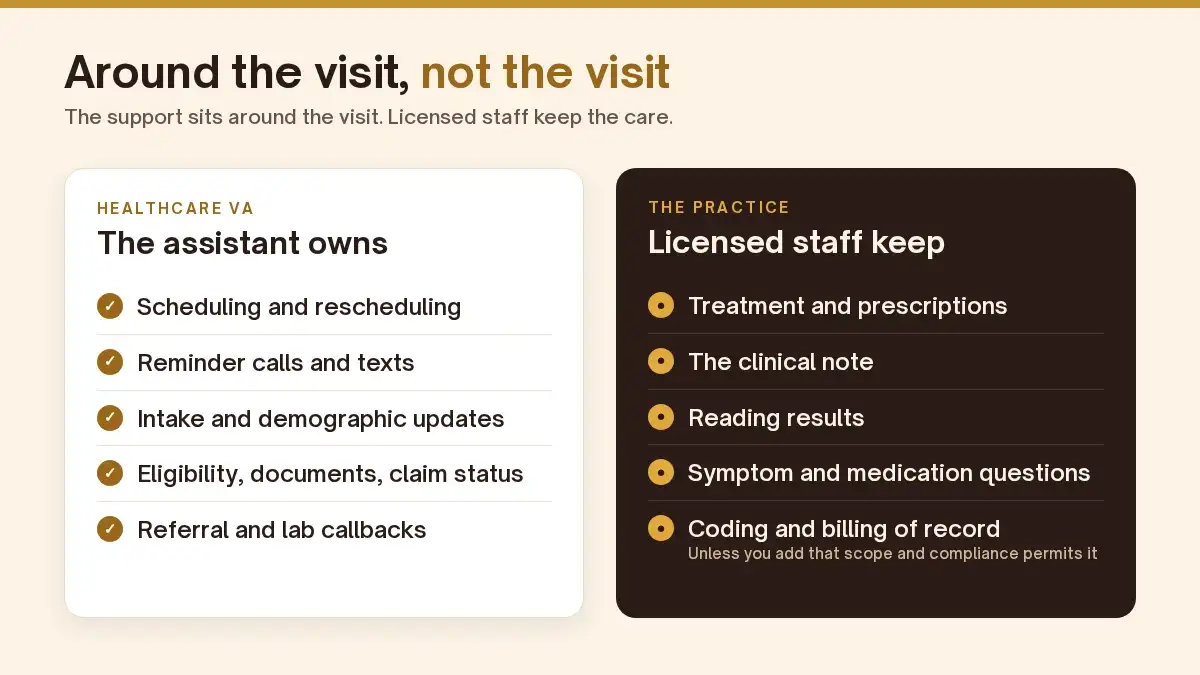
The support sits around the visit. Licensed staff keep the care. The assistant owns scheduling and rescheduling, reminder calls and texts, intake and demographic updates, eligibility, documents, and claim status, and referral and lab callbacks. Licensed staff keep treatment and prescriptions, the clinical note, reading results, and symptom and medication questions. Coding and billing of record stay with them unless you add that scope and compliance permits it.
The same split, in a law practice, is the one in how a legal virtual assistant recovers billable hours: the assistant can move the calendar, and the licensed person keeps the judgment. The wider line — advice, diagnosis, and the signature stay with the licensed person — is in what a virtual assistant takes off your plate.
Where HIPAA meets the calendar
Scheduling, reminders, intake forms, and insurance follow-up can involve protected health information. That is a description of the data. It is not a certification of the person doing the scheduling.
The U.S. Department of Health and Human Services describes the roles this way. The HIPAA Privacy, Security, and Breach Notification Rules apply to covered entities: health plans, health care clearinghouses, and health care providers who transmit health information in electronic form in connection with a covered transaction. Some provisions also apply directly to business associates. In general, a business associate is someone other than a member of the covered entity's workforce, engaged to carry out certain activities or services that involve the use or disclosure of protected health information. HHS says the Rules permit a covered entity to disclose that information to a business associate if the covered entity obtains satisfactory assurances, in a contract or other written arrangement called a business associate agreement, that the information will be safeguarded. (HHS business associate guidance)
The Privacy Rule states the same condition in regulation. A covered entity may disclose protected health information to a business associate, and may allow that associate to create, receive, maintain, or transmit the information on its behalf, if the covered entity obtains satisfactory assurance that the associate will safeguard it. Those assurances have to be documented in a written contract or other written arrangement that meets 45 CFR 164.504(e). The disclosure condition itself is 45 CFR 164.502(e).
Meet My Assistant's healthcare page does not call the assistant HIPAA-certified, and it does not sell a separate records system. It says assistants sign confidentiality agreements and work only inside the systems you grant. Clinical care is not part of the seat. When a practice wants a business associate agreement, the page says that discussion happens on the discovery call, before access is turned on. This article does not decide whether your practice is a covered entity, or whether a particular arrangement is a business associate relationship. Exceptions exist, and the facts matter. That determination belongs to your compliance counsel. Nothing here is legal advice.
What to lock before the first reminder goes out
Three choices make the research above usable in a real book:
- The channel for the reminder, call or text or both, and the day you send it.
- The exact words for cancel and reschedule, and who is allowed to refill a slot without a clinician.
- Which insurance and referral items are in scope before the visit, and which items are not.
Book a discovery call when you want that loop mapped onto your own book.