Blog
How Real Estate Virtual Assistants Can Help Realtors Close Deals Faster and Stay Organized
November 28, 2024 · Updated Oct 22, 2026 · Mauricio Montaldo
A real estate virtual assistant keeps the listing file, the showing calendar, and the follow-up current while the agent is with a client. The license stays on the agent.
- Top 1% applicants
- Time-zone aligned
- 98% retention
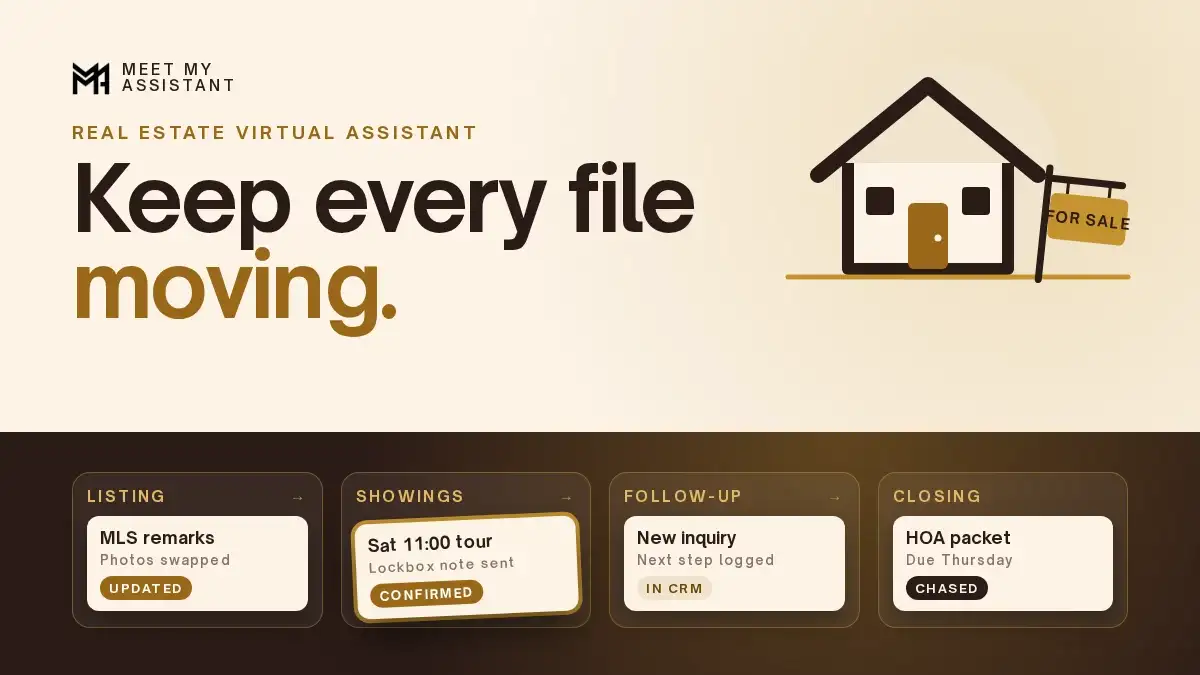
The assistant owns the operational loop around the deal.
That split is the whole job. Listing appointments, buyer tours, and negotiations are the conversations that pay. Stale remarks, an unconfirmed tour, a lead with no note, and a missing document two days before closing are the work that stalls those conversations. An assistant can take the second pile. An assistant cannot take the first.
The listing file, before anyone tours the house
Start with the file the public can see. The assistant submits listing changes and edits the multiple listing service entry: remarks, photos, the description, and the status when you say it changed. A photo that never got swapped, or a status that still says active after you went pending, is an admin miss. It is also the kind of miss that creates a question you did not need.
The same person can request public-record documents that do not require a license to obtain. Deeds and tax information are the usual pair. You still read them. The assistant fetches what you named and files it where the checklist says it goes.
Sign placement belongs in this lane when you want it delegated. For-sale and for-rent signs are a field task, not a pricing conversation. If your market treats the sign as something an unlicensed person may place, put the address, the sign type, and the deadline in the brief. If your brokerage says only the agent places signs, leave it off the list. The assistant follows the rule you write down.
What does not belong in the listing file is a promise about price, terms, or who the buyer should use. Those sentences stay in your voice, on a draft you approved, or they do not go out.
Showing day, without sitting the open house
The calendar is a confirmation problem. The assistant lines up showings and client meetings, sends the confirmation, records lockbox or access notes, and asks for feedback after the tour. The agent still walks the property with the prospect.
An unlicensed assistant does not show a home to a prospective purchaser. They do not solicit a listing or a management contract. They do not discuss the listing, the offer, or the contract with the other side. If a buyer asks “what should I offer?” on a text thread the assistant is watching, the reply is a hold and a handoff, not a number. Each state's real estate commission sets those limits, as in the Maryland Real Estate Commission guidelines and the New Jersey Real Estate Commission support-staff list.
Write that stop rule before the first showing week, using the Handle / Draft / Stop inbox rule. Include who gets the thread, how fast, and which phrases are already approved for “the agent will answer that.” A fluent reply that invents a price is worse than a short delay.
Feedback requests are part of the same day. After the tour, the assistant asks the question you approved and logs the answer in the transaction file or the CRM. You use the answer at the next appointment. You do not need to be the person who typed the ask.
The week a file is trying to close
Transaction work is a checklist with dates. The assistant tracks what is due, chases the document that is still missing, and updates the date when a party moves it. Coordination here means the file stays complete. It does not mean the assistant interprets the contract or tells a client what the clause does.
Document chasing is repetitive and easy to drop when you are in back-to-back appointments. A title request, a disclosure the seller has not returned, an HOA packet, a signed form that is sitting in email: name each one on the checklist and the assistant can nudge the person who owes it. You step in when the nudge needs a licensed explanation.
Bookkeeping sits next to this only when you assign it and it does not require a license. Reconciling a file, filing an invoice, or updating a spreadsheet you already use is work for an administrative virtual assistant. Advice about how a client should structure a purchase is not. If the task is ambiguous, it stays with you.
CRM follow-up after the inquiry lands
The CRM is where deals go quiet. A new lead, speed-to-lead follow-up, and the drip you already approved are assistant work. So are appointment reminders, a tour recap you signed off on, and vendor scheduling. The assistant writes the note in the system you already run. Use the MLS membership, the CRM, and the transaction folder you pay for now. The hire does not install a new stack.
Speed matters because the record gets colder while you are in a showing. The assistant is not the closer. The assistant is the person who answers with the next step you defined: a time on the calendar, a question from your script, or a flag that this one needs you. A thread that turns into price, terms, or representation leaves the sequence.
Bilingual follow-up belongs in the same system when buyers, sellers, or vendors write in Spanish. The reply goes out in the language they used, from a template you approved in both languages. That is a brief you bring to the match. It is not a second product.
Marketing that should not wait for a free hour
Listing flyers, social drafts, and open-house logistics can move on a day you are in appointments. The assistant prepares the draft. You approve anything that states a price, a feature you have not verified, or a claim about the neighborhood.
Email campaigns and website updates are the same pattern. The campaign is built from copy you approved, and the website change is the one you asked for. The assistant does not invent a new offer to “keep the page fresh.”
Social posting follows the same gate. A draft can be scheduled. An ad account, a boosted post, or a claim you did not write is a separate decision, and it is not assumed in the seat. If you want that work, name it on the discovery call and keep approval on your side.
Who actually needs this day covered
One producer with a modest listing book can often cover this with part-time hours. The test is whether the inbox, the calendar, and the database still move on days spent in appointments.
A team feels the gap when every producer is out at once and nobody is left to confirm the next tour or log the new inquiry. One seat can sit between the people writing offers and the person watching dates. It is the same job, pointed at a shared checklist.
A shop with several producers uses the seat so each agent is not waiting on a private coordinator. Listing files, deadline tracking, and client notes can be one person’s work across that group. That person is still not the agent of record on any file.
What a real estate virtual assistant costs, and why there is no rate card
Meet My Assistant does not publish an hourly rate for this seat. Full-time and part-time are both in the model. The US hiring page says the quote comes after the role is mapped. Hours, source, and scope are why one agent’s number is not another agent’s number. A public “from” price would be a guess.
Local coordinators are a different comparison, and this article will not invent their wages. The practical difference is who recruits. On a marketplace you source, train, and replace the person yourself. Here you interview a shortlist, and a Customer Success Manager remains assigned after that approval. The assistants are college-educated and live in Latin America. You still decide who opens the database.
How the first week is supposed to go
The sequence is a discovery call, then your interview, then onboarding into the tools you already use.
On the call, name how many listings are live, which CRM stages matter, how showings get confirmed, and which sentences the assistant must not send. Bring last month’s messy examples: a listing that went stale, a tour that was never confirmed, a lead that sat, a document that almost missed closing. Those four are the brief.
You meet the shortlist. Access to the MLS and the CRM comes after your yes, with role-based logins. The first packet is the checklist, the approved replies, and the escalation list. Day one should be a real file, not a tour of the software.
If the fit fails later, you are not recruiting from scratch between closings. The account stays with the US team, and the seat is the thing that gets replaced. Your database access is something you can turn off the same day.
The commercial version of this offer, including who the seat is for, lives on the real estate virtual assistant page. This article is the day-to-day. That page is where you hire.