Blog
Bilingual Virtual Assistant: Can One Hire Cover Both Languages?
October 22, 2026 · Mauricio Montaldo
A bilingual virtual assistant is one hire who can answer in English or Spanish, in the language the customer used. That is the right shape when both languages land in the same inbox, calendar, or intake queue.
- Top 1% applicants
- Time-zone aligned
- 98% retention
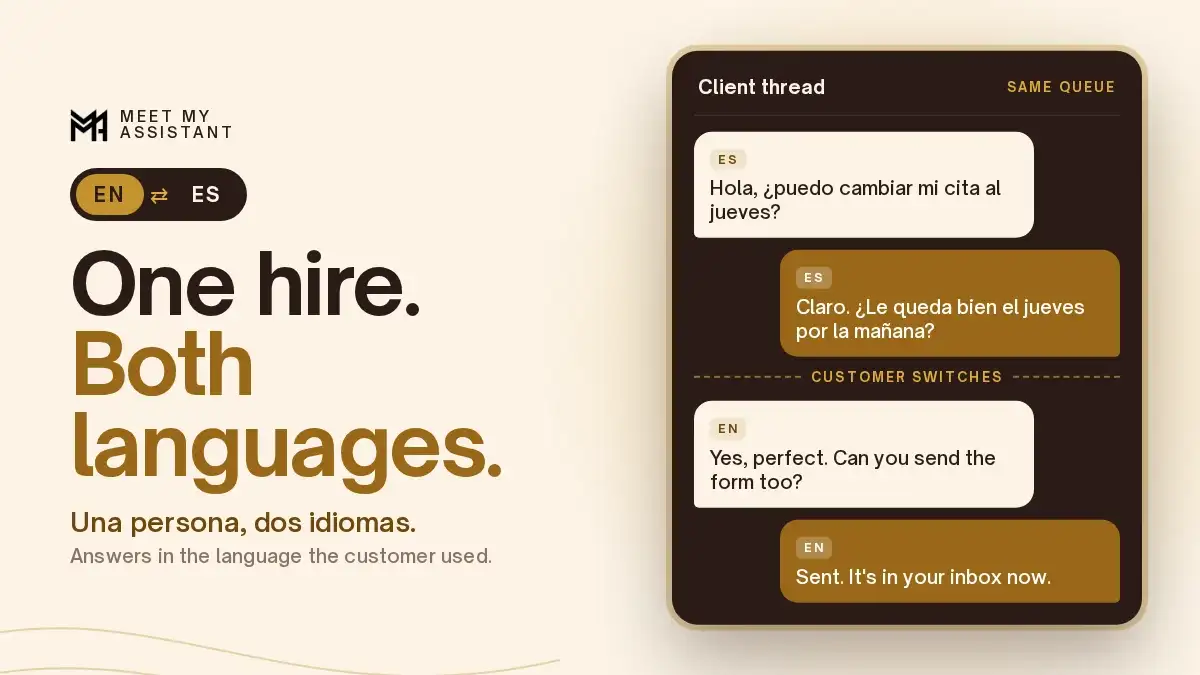
The wrong shape is a second language you hope they will pick up after the start date. Meet My Assistant already matches bilingual, college-educated assistants for US companies. You interview before anyone is placed. This guide is the decision in front of that interview: which queues need both languages, what to test, and when one person is enough.
When one hire can cover both languages
One person covers both languages when three things are true.
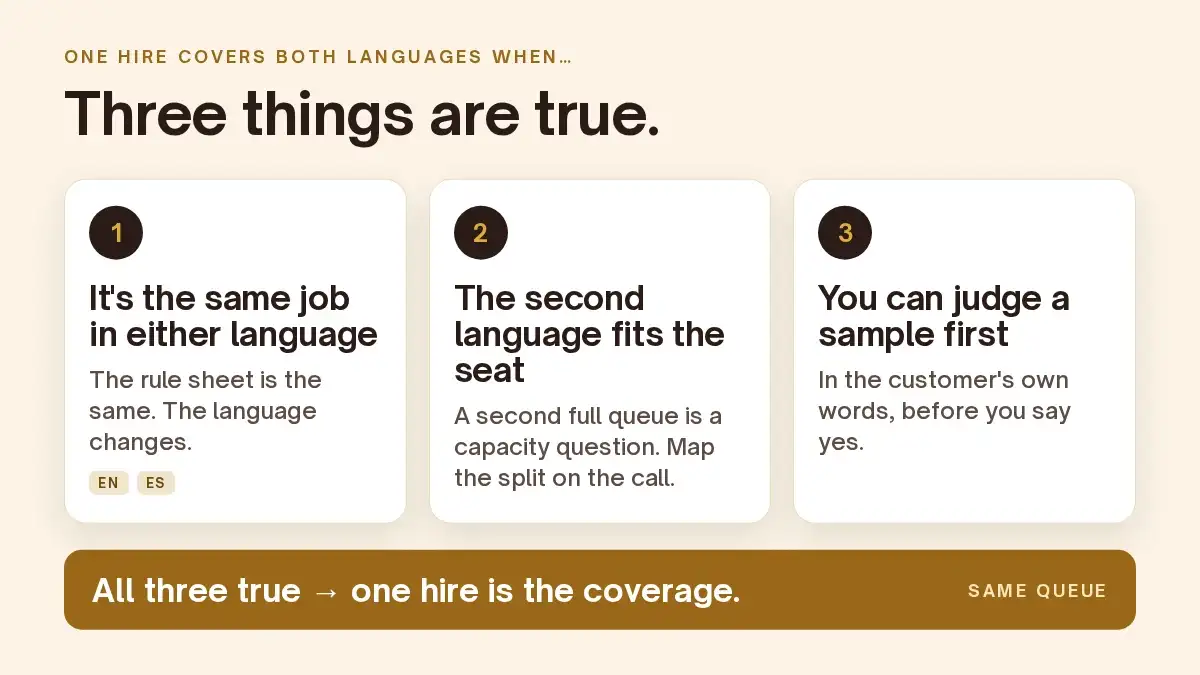
The work is the same job in either language. A scheduling reply, an intake form, a status update, and a CRM note do not become a different profession because the customer wrote in Spanish. The rule sheet is the same. The language changes.
The volume of the second language fits inside the seat you are buying. A handful of Spanish threads a day belongs on the same person who already owns the inbox. A second full queue is a capacity question, and the US hiring page says a full-time or part-time quote comes after the role is mapped. Map the split on that call. Do not guess it from a job title.
You can judge the second language before you say yes. A short sample, in the customer's words, tells you more than a line on a résumé that says "bilingual."
If those three are true, one hire is the coverage. If the second language is rare, an English-only seat is simpler and you should say so on the discovery call. If both languages are each a full day, say that too, and let the match follow the map.
What the language numbers are actually measuring
A national headcount is not a forecast for your inbox. It does tell you the second language is ordinary in the United States, not a niche you can ignore until a complaint arrives.
In the Census Bureau's 2024 American Community Survey 1-year estimates, table C16001, 44,867,700 of 321,745,950 US residents age 5 and older spoke Spanish at home. That is 13.9 percent. Inside that Spanish group, 26,435,478 spoke English "very well," and 18,432,220 spoke English less than "very well." The table is C16001 for the United States.
"Spoke Spanish at home" is not the same claim as "cannot use English." The split inside the table is the useful part. A large group speaks both well. Another large group will struggle with an English-only reply. Your queue might be either group, or a mix. The only way to know is to look at the last month of messages, not the national percentage.
Bring that month to the discovery call. Count threads that arrived in Spanish, threads where the customer switched mid-conversation, and threads where a family member wrote because the patient or client was more comfortable in Spanish. That count is the brief. The Census table only explains why the brief is worth writing.
Roles where both languages show up in one queue
The seat follows the workflow you already have. These are the places Meet My Assistant pages already describe English and Spanish in the same kind of work.
Law firm intake
Legal virtual assistant work on the existing page includes calendar, client intake, document prep, and client communication. The same page says English and Spanish intake and client updates help firms serve more clients. That is a bilingual seat when the callers and the email are mixed, and the attorney still keeps the advice.
Test this role with a redacted intake email in each language and the conflict-check packet you already use. You are checking whether the assistant follows your form, not whether they can practice law. They cannot. The page is explicit that this seat does not give legal advice.
Healthcare scheduling and follow-up
A healthcare virtual assistant on the existing page handles patient scheduling, reminders, records, insurance follow-up, and bilingual patient communication so Spanish-speaking families get a real answer. Licensed staff keep clinical care. The language decision sits in scheduling, reminders, and insurance questions, which the page already names as the useful bilingual work.
Test this role with one reminder you approve in English and the same reminder in Spanish, plus one insurance-status reply that must escalate when the answer is not on the rule sheet. If the Spanish version drifts into clinical advice, that is a fail, even if the grammar is perfect.
Customer service for people who are already clients
Customer service support is the seat for the clients you already have: inbox and ticket triage, status updates, scheduling, CRM notes, and escalation when a human decision is required. Use a bilingual hire here when those clients write in both languages and you want the answer in the language they used.
The test is a thread, not a slogan. Paste two real replies you were happy with, one in each language, and one thread that should have been escalated. Ask the assistant to answer the easy ones and stop on the exception. Tone and the stop rule matter more than a fluent paragraph that promises a refund you did not approve.
Miami inboxes that switch languages
The Miami page describes work that is often bilingual, with one inbox switching English and Spanish across real estate, trade, and client success. If that is the market you sell into, the bilingual requirement belongs in the brief on day one. A statewide or national page will not spell out that mix for you. The Los Angeles virtual assistant page is that same brief for a Pacific-time inbox: answer in the language the customer used.
What to test before you approve the hire
You already interview the shortlist. Use the interview to test the language, not to chat about it.
Send the sample the day before, in both languages, with the names removed. Ask for a reply in the language of each message. Then ask one follow-up in the other language, the way a customer actually switches. A person who can only produce a polished paragraph from a script will stall on the switch.
Score four things, and write them down so the US team can see the same sheet you used.
- Right language. The reply matches the customer, including a thread that changes language in the second message.
- Your facts. Dates, names, and next steps match the source you provided. Nothing is invented to sound helpful.
- The stop rule. Refunds, legal advice, clinical answers, and price exceptions stay with you. The reply says who will take it from here.
- The tool. The CRM note or the calendar hold is filled the way your stack already works. A beautiful email that never lands in the system is a miss.
Meet My Assistant screens college-educated candidates against the brief you write on the discovery call. The interview is still yours. Access to the inbox comes after you approve the person.
How coverage works after the yes
Onboarding is the rule sheet, the logins, and the escalation list. A Customer Success Manager stays on the account. If availability changes, the hiring page says the agency replaces the seat. Say in that packet which templates exist in both languages, and which replies must stay in English because the legal or clinical wording was approved in one language only.
Shift hours are set on the discovery call. Do not assume a bilingual seat means overnight coverage. It means the person matched to the seat can work in both languages during the hours you wrote down.
Tools stay the ones you already run. After you approve the person, the US hiring page says access is granted in that stack: Google Workspace, Microsoft 365, your CRM, or your phone system. A bilingual hire does not require a new platform.
When one person is the wrong shape
Ask for a different map when any of these are true.
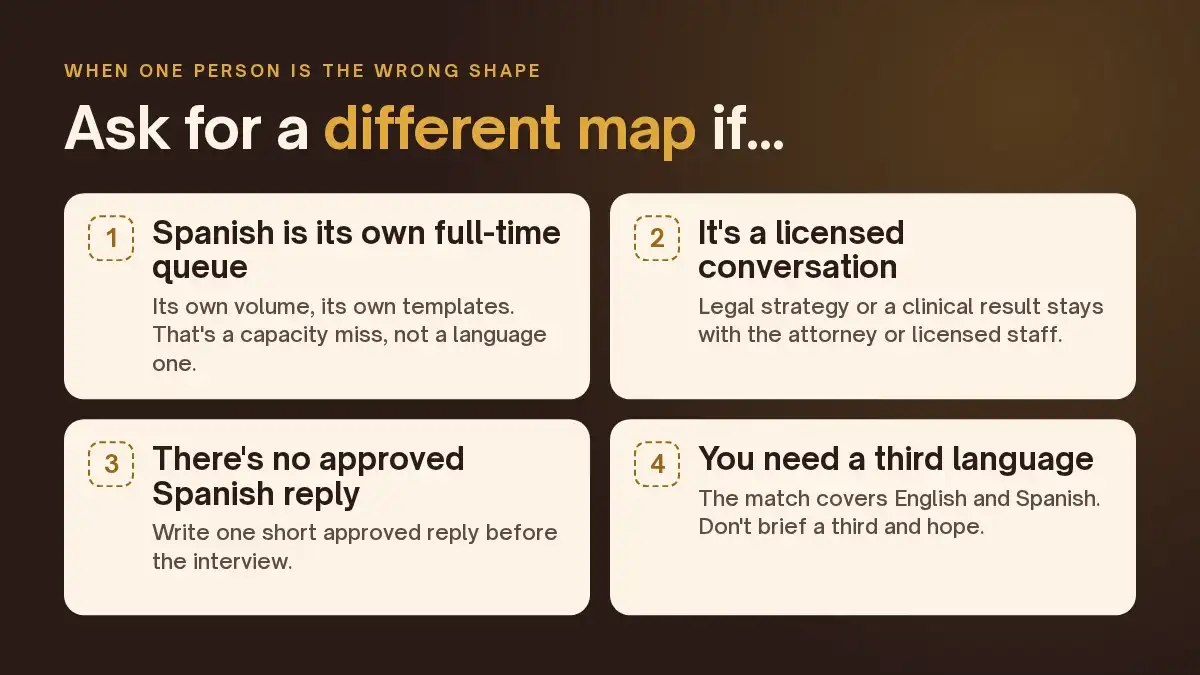
The Spanish work is a separate full-time queue, with its own volume, its own templates, and no idle time in the English queue. Putting both on one person creates a backlog you will blame on language. It is a capacity miss.
The second language is a licensed conversation. Interpreting a legal strategy or a clinical result is not intake and it is not a reminder. Keep that with the attorney or the licensed staff, in whichever language they use with the client.
You cannot produce a sample. If you have no approved reply in Spanish, the assistant will invent tone on day one. Write one short approved reply before the interview, even if it is ten lines. That is the standard they will be measured against.
You need a language the match does not claim. These pages describe English and Spanish. Do not brief a third language and hope the same seat covers it.
FAQ
FAQ
Yes, when both languages are the same job and the volume fits one seat. Meet My Assistant matches bilingual English and Spanish assistants, and you approve the person after an interview. A second full queue is a mapping question, not a reason to pretend one person has two workdays.
Start with the queues that already mix languages on the existing pages: law-firm intake and client updates, healthcare scheduling and insurance questions, customer service for current clients, and Miami inboxes that switch between English and Spanish. An internal report that nobody outside the company reads can stay in one language.
A real sample in each language, plus one message that switches language, plus one case that must escalate. Check the language, the facts, the stop rule, and the CRM or calendar entry. Fluency without the stop rule is a fail.
Not by default. Use one hire when the Spanish work fits inside the seat. Use the discovery call to map a larger seat, or a different one, when the second language is itself a full day's work. The quote comes after that map, not from a public rate card.